Zyphra Audio
ZONOS3-Mini
High-quality, reliable speech. Just 100M active parameters.
About
ZONOS3-Mini is Zyphra’s compact, open-source text-to-speech model, delivering natural reliable speech and high-fidelity voice cloning with just 100 million active parameters. It runs in real time on phones and laptops, including directly in the browser. Clone a voice from an audio sample, or design a character by shaping age, accent and vocal texture. Steer emotion, pace and delivery down to individual words for games, narration and voice assistants. Run ZONOS3-Mini locally with our browser and native runtimes, or access it through Zyphra Inference. Model weights are released under Apache 2.0.
Qualitative Comparisons
Trailer Voice
“I must not overfit. Overfitting is the model-killer. Overfitting is the little loss that brings total generalization failure. I will face my loss. I will permit the gradient to pass backward over me and through me. And when it has propagated, I will turn the validation eye to see its path. Where the loss has gone there will be convergence. Only the learned representation will remain.”
 Zyphra
 Fish Audio
 Qwen
 Cartesia
 ElevenLabs
 OmniVoice
Parks and Recreation Guy
“You leak your test set? Straight to jail. No validation, no nothing. Data scientists, we have a special jail for data scientists. You overfit? Jail! You underfit? Also jail! Overfit, underfit. You normalize the training data but not the test data? Jail, right away. You tune hyperparameters on the leaderboard? Believe it or not, jail! You call it AI when it’s just logistic regression? Jail! You use a neural net for a problem solved by a decision tree? Jail! You forget to set a random seed? Jail! You set the seed but don’t log the experiment? Also jail! You say 'the model is 99% accurate' on an imbalanced dataset? Right to jail! You deploy without monitoring drift? Jail, immediately.”
ZyphraFish AudioQwenCartesiaElevenLabsOmniVoiceDwarkesh
“I guess what’s interesting is that it no longer has that synthetic, slop-y cadence you expect from these models. It actually feels like you're talking to a person, right? And maybe the M.O.E thing is actually doing a lot of work here. You get the feel of a much bigger model but with great realtime performance at the same time.”
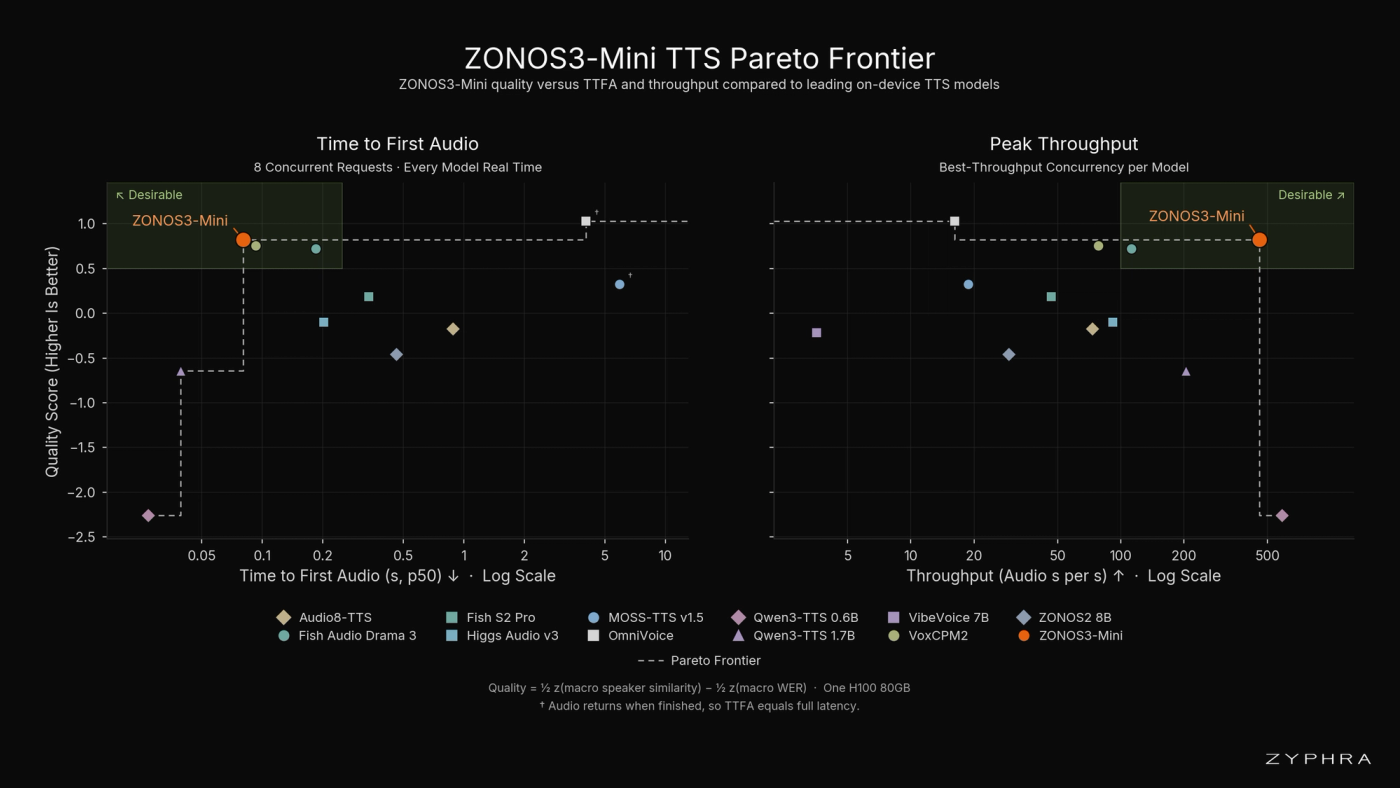
ZyphraFish AudioQwenCartesiaElevenLabsOmniVoiceQuantitative Comparisons
API usage
import os
from openai import OpenAI

client = OpenAI(
    api_key=os.getenv("ZYPHRA_API_KEY"),
    base_url="https://api.zyphracloud.com/api/v1",
)

response = client.audio.speech.create(
    model="zyphra/zonos3-mini",
    voice="Savannah",
    input="Hello!",
)

with open("speech.wav", "wb") as f:
    f.write(response.read())
import fs from "fs";
import OpenAI from "openai";
const client = new OpenAI({
apiKey: process.env.ZYPHRA_API_KEY,
baseURL: "https://api.zyphracloud.com/api/v1",
});
const response = await client.audio.speech.create({
model: "zyphra/zonos3-mini",
voice: "Savannah",
input: "Hello!",
});
const buffer = Buffer.from(await response.arrayBuffer());
fs.writeFileSync("speech.wav", buffer);curl https://api.zyphracloud.com/api/v1/audio/speech \
-H "Authorization: Bearer $ZYPHRA_API_KEY" \
-H "Content-Type: application/json" \
-d '{
"model": "zyphra/zonos3-mini",
"voice": "Savannah",
"input": "Hello!"
}' \
--output speech.wav