Zyphra Research
Zyphra's research thesis focuses on three pillars to deliver superintelligence.
Explore our latest announcements
New
Browse More
All Technology
Research
Model
Press

Research
Expert Coupling in MoE Pretraining
Mixture-of-Experts (MoE) models scale model capacity efficiently by routing each token to only a small subset of experts. But at large scale, the cost of moving tokens between GPUs can become a major bottleneck, accounting for as much as 60.4% of total training step time in our experiments. In this work, we show that MoE routing contains substantial structure that can be exploited to reduce this communication. Experts selected by the same token are strongly correlated within a layer, while a token’s expert choices in one layer predict where it will be routed in later layers. We use these two properties to increase token–expert locality in two complementary ways: correlated expert placement co-locates experts that are frequently selected together, while token shuffling proactively moves tokens to the GPUs likely to contain their next experts. Neither technique changes the model architecture or its routing decisions. Moreover, we find that these routing patterns are cheap to estimate and emerge early enough in training to remain useful over long stretches of pretraining. In Megatron-LM experiments on MI300X GPUs, our methods reduce all-to-all communication time by up to 2.63× and improve end-to-end training step time by up to 1.41×.
Research
How Hybrid NoPE Models Learn Position Without Position Encodings
Zyphra Research investigates how hybrid language models can recover positional information even when their global attention layers use no explicit position encoding (NoPE). We find that local layers such as sliding window attention (SWA) and gated linear attention naturally create a recency bias in the model’s residual stream, meaning that representations of nearby tokens become more similar than representations of distant tokens. We find that this recency bias then propagates through the model, where the query and key projections of global NoPE attention learn to read it out. The result is an implicit relative position encoding in attention layers that, on their own, have no direct access to token position. Our results provide a mechanistic explanation for why architectures interleaving local mixing with global NoPE attention can work so well, and point toward a promising way of building positional representations that extrapolate naturally beyond the sequence lengths seen during training.

Research
PUFFER: Incremental Fuzzy Deduplication for Continuously Evolving Corpora
Zyphra introduces PUFFER, a provenance-aware incremental fuzzy-deduplication system for continuously growing training corpora. PUFFER maintains a faithful, disk-resident MinHash locality-sensitive hashing history that can ingest new datasets, recover deterministically from interrupted jobs, and remove individual datasets without repeatedly rebuilding the full corpus index. PUFFER achieves an 11x-35x speedup over existing CPU-based deduplication methods when tasked with processing up to one billion documents over a ten-hour throughput test. At the deduplication (index) layer, PUFFER ingests one billion documents in 1.75 hours on a single process, and is deployed in production on more than 30 billion documents. Available as open-source software under a permissive Apache 2.0 license.

Model
ZUNA1.1: A More Flexible EEG Foundation Model for Denoising and Super-Resolution
Zyphra releases ZUNA1.1, an Apache 2.0-licensed EEG foundation model that reconstructs, denoises, and upsamples data across arbitrary channel layouts. Designed for real-world recordings, we build upon our previous EEG foundation model, ZUNA1, while matching or exceeding its reconstruction quality and substantially expanding its range and flexibility. ZUNA1.1 now accepts variable length inputs from 0.5-30 seconds and performs reconstructions across arbitrary subsets of channels and time.
This post is an update to Zyphra’s ZUNA1.1 release July 16, 2026. The ZUNA1.1 technical paper is now available on arXiv and an updated version of the EEG Playground is available on Zyphra Cloud, now with more features.

Research
Plasticity Loss in Continual Learning
Zyphra Research studies the loss of the ability to learn after continued training—loss of plasticity—in GPT-style decoder-only Transformers. We discover that models with 5M to 314M non-embedding parameters lose plasticity when trained on a multilingual continual learning problem, as measured by deterioration on a held-out probing task. We derive a scaling law predicting that the onset of plasticity loss scales sublinearly with the number of non-embedding parameters. This prediction implies that scaling the number of parameters to prevent plasticity loss has diminishing returns and may be an inefficient approach to addressing the problem. In addition, we demonstrate that plasticity loss also occurs during stationary learning, suggesting that current approaches to training large language models are similarly susceptible to plasticity loss. Our work indicates that loss of plasticity might be a key bottleneck for full continual learning of LLMs.
Research
Scaling Adaptive Depth with Norm-Agnostic Residual Networks
Zyphra introduces the Norm-AGnostic residual network (NAG), a residual architecture that treats the residual stream as a computational rotation system. NAG decomposes the residual stream into separate norm and direction lanes: layers operate solely upon the normalized direction through controlled orthogonal rotations, while norm is carried separately as a confidence-like signal. This lets layers contribute consistently across depth and enables an interpretable form of Mixture-of-Depths adaptive computation, where FLOPs saved by skipping layers can be traded for training on more tokens under a fixed compute budget. To our knowledge, this is the first practical justification for sparse depth as a pretraining-time scaling axis for efficient deep models.
Model
ZONOS2: Real-time TTS with High-Fidelity Voice Cloning
Zyphra has released ZONOS2, an Apache 2.0-licensed real-time text-to-speech model high in expressiveness, with strong voice cloning, and a first-of-its-kind MoE architecture among open-source TTS systems.
Research
Implementing Inference Communication Overlap on AWS Inferentia2
In collaboration with AWS, Zyphra Research evaluated the AWS Trainium/Inferentia[^1] hardware stack and AWS Neuron software stack for its potential use in workloads where communication and memory movement dominate cost, including decode-bounded inference, long-context attention, and MoE-style models. To test this regime, we implemented Domino-style tensor-parallel communication overlap within the AWS Neuron inference stack and benchmarked Llama 3-8B across varying NeuronCore counts on Inferentia2. Our results improve aggregate output throughput and reduce both time-to-first-token and time per output token, with the clearest gains appearing at higher tensor-parallel widths where collective communication becomes a larger portion of the critical path. This work demonstrates Zyphra’s ability to optimize across the Trainium/Inferentia stack and highlights the systems work required to unlock performance across multiple hardware ecosystems.

Research
Equilibrium Propagation Beyond Energy Based Models
Zyphra Research demonstrates how Equilibrium Propagation (EqProp), a local learning algorithm traditionally limited to Energy-Based Models (EBMs), can be extended to a broader class of dynamical systems known as skew-gradient systems. These systems combine energy-storing and nonlinear dissipative dynamics, and include biologically realistic neuron models such as the FitzHugh-Nagumo model. Our results provide a path toward biologically plausible gradient-based learning and represent a step toward more efficient AI architectures and learning algorithms that move beyond conventional GPU-based computing.
Research
Benchmarking Zyphra Inference: Production Performance on MI355X
Building on our launch of Zyphra Cloud, today we publish the first end-to-end benchmarks for Zyphra Inference on AMD Instinct™ MI355X GPUs. We show inference metrics achieved on a single node of MI355X GPUs on our cloud for Kimi K2.6, GLM-5.1 and DeepSeek V3.2 compared to the baseline AMD MI355X and Nvidia B200 inference configurations. These results reflect the first phase of our broader full-stack inference optimization effort across kernels, parallelism, communication, quantization, and speculative decoding.
Model
ZAYA1-8B-Diffusion-Preview: Efficient Parallel Decoding on AMD
Zyphra presents ZAYA1-8B-Diffusion-Preview, a preview of our early work in diffusion-language models. We demonstrate that we can convert the existing ZAYA1-8B language model, which was trained autoregressively, into a discrete diffusion model with no systematic loss of evaluation performance. ZAYA1-8B-Diffusion-Preview diffuses blocks of 16 tokens simultaneously resulting in a 4.6x speedup with a lossless sampler and 7.7x speedup with our new logit-mixing sampler. ZAYA1-8B-Diffusion-Preview is the first MoE diffusion model converted from an Autoregressive LLM and the first diffusion-language model trained on AMD.

Model
ZAYA1-VL-8B: Efficient Open Visual Intelligence
Zyphra releases ZAYA1-VL-8B, a vision-language model building on the ZAYA1-8B-base. ZAYA1-VL-8B is an MoE model with 700M active and 8B total parameters. ZAYA1-VL-8B excels at visual understanding, grounding, and OCR-type tasks. The model is released under an Apache 2.0 license and the weights are available here.

Model
ZAYA1-74B-Preview: Scaling Pretraining on AMD
Zyphra releases a preview of ZAYA1-74B, an MoE model with 4B active and 74B total parameters, demonstrating large-scale pretraining capabilities end-to-end on AMD. ZAYA1-74B-Preview is a pre-RL reasoning-base checkpoint, released under an Apache 2.0 license. Weights and model card are available here.

Model
ZAYA1-8B: Frontier intelligence density, trained on AMD
Zyphra releases ZAYA1-8B, an AMD-trained MoE model which performs strongly on complex reasoning, mathematics, and coding tasks.
Research
Folding Tensor and Sequence Parallelism for Memory-Efficient Transformer Training
Zyphra presents Tensor and Sequence Parallelism (TSP), a novel parallel sharding strategy for training and serving long-context transformer models.
Research
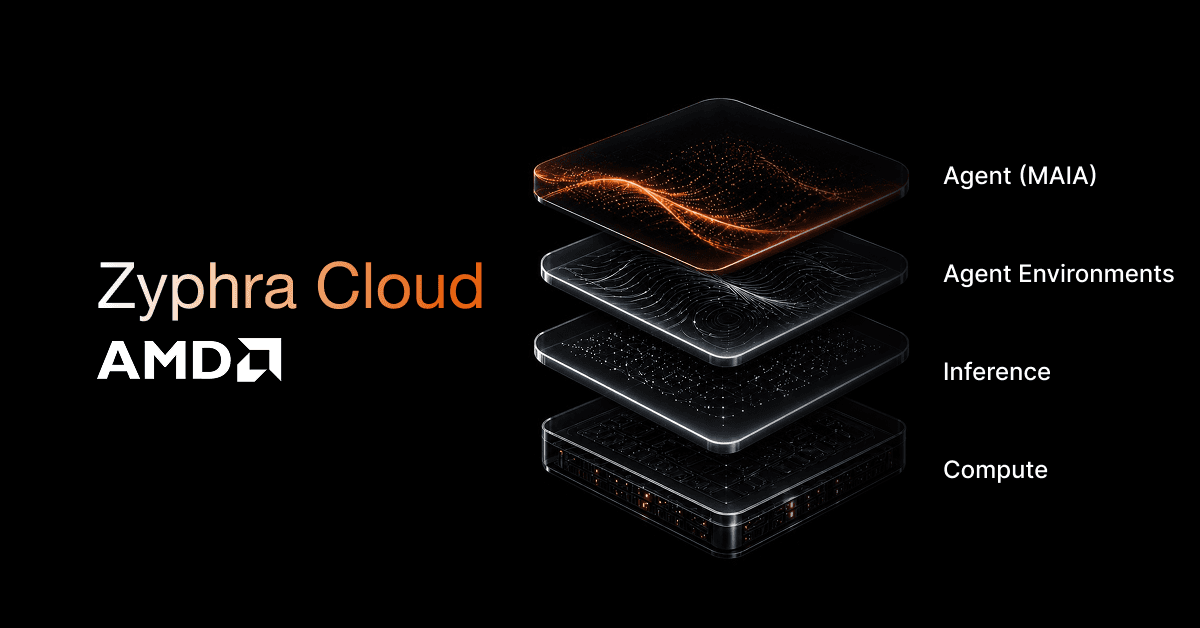
The Zyphra Inference Cloud: AMD-First Inference for Long-Context, Agentic Workloads
Zyphra Cloud is a full stack AI platform bringing advanced innovations from Zyphra Research into production for developers, enterprises, and frontier AI hyperscalers. Today, we launch the platform with Zyphra Inference, an AMD-first inference service purpose-built for large open models focused on long-context agentic workloads. Zyphra Inference marks the first step toward a unified platform for open, sovereign AI at scale.

Research
Hybrid Associative Memories
Hybrid Associative Memory (HAM) leverages complementary strengths of RNNs and attention. In HAM, the KV cache maintains long-range details by storing only those tokens that are unpredictable by the RNN. HAM shows strong performance relative to the Transformer at a fraction of the cache size.

Model
ZUNA: BCI Foundation Model Advancing Towards Thought-to-Text
ZUNA is a 380M-parameter BCI foundation model for EEG data, a significant milestone in the development of noninvasive thought-to-text. ZUNA reconstructs, denoises, and upsamples EEG data across arbitrary channel layouts and is built for researchers, clinicians, and BCI developers using real world data.

Research
Online Vector Quantized Attention
In this blog, we describe a novel sequence mixing layer developed here at Zyphra that aims to find a better compromise between memory-compute costs and long-context capabilities than standard sequence mixing layers. We call this layer Online Vector-Quantized (OVQ) attention.
Model
ZAYA1 – Pretraining on Integrated AMD Platform: Compute, Network, and System Design
Zyphra announces a preview of ZAYA1, the first AI model trained entirely end-to-end on AMD’s hardware, software, and networking stack. Details of our pretraining efforts, hardware specific optimizations, and ZAYA1-base model benchmarks are described in the accompanying technical report published to arXiv.
Research
CCA - Compressed Convolutional Attention: Efficient Attention in a Compressed Latent Space
Zyphra shares its research into a novel attention variant: Compressed Convolutional Attention (CCA). CCA dramatically reduces the compute, memory, and parameter costs of self-attention while matching or exceeding the performance of existing methods. Details of CCA and its grouped-query variant CCGQA are described in the accompanying technical report published to arXiv. CCGQA has been subsequently used to train the ZAYA suite of language models.

Model
Introducing ZR1-1.5B, a small but powerful reasoning model for math and code
We introduce ZR1-1.5B, a small reasoning model trained extensively on both coding and mathematics problems with reinforcement learning. ZR1-1.5B outperforms many significantly larger general non-reasoning models on code generation, while maintaining performance close to state-of-the-art small reasoning models trained exclusively on math on competition-level evaluations.
On LCB_Generation ZR1-1.5B achieves parity with Claude3-Opus and Gemma2-27B, while on competition math ZR1-1.5B outperforms Qwen2.5-72B. Unlike comparable reasoning models, ZR1-1.5B requires significantly shorter reasoning traces, using 60% fewer tokens than R1-Distill-1.5B and 53.5% fewer tokens than DeepScaleR.
Overall ZR1-1.5B demonstrates strong generalization across disparate domains as well as coherent and efficient reasoning traces compared to models of a similar scale.
Model
Beta Release of Zonos-v0.1
We are excited to announce the release of Zonos-v0.1 beta, featuring two expressive and real-time text-to-speech (TTS) models with high-fidelity voice cloning. We are releasing our 1.6B transformer and 1.6B hybrid under an Apache 2.0 license.

Research
The Mixture-of-PageRanks Retriever for Long-Context Pre-Processing
In this post, we describe our Mixture-of-PageRanks RAG system, which is built to perform long-context tasks in a highly computationally efficient manner. We describe key features of the algorithm and the SOTA results it achieves across a variety of long-context benchmarks. MixPR can augment any existing foundation model, robustly outperforms frontier long-context models on a variety of benchmarks and can extend effective LLM context lengths into the billions while being able to run efficiently on CPU.
Research
Frontier Training Kernels for Transformers (FA2) and SSMs (Mamba2) on AMD Instinct MI300X Accelerators
In this blog, we demonstrate the first backwards kernels to surpass H100s for both transformers (Flash Attention v2) and hybrid models (Mamba2), which enables training foundation models on AMD Instinct MI300X accelerators.
Research
Reaching 1B context length with RAG
We demonstrate a retrieval system extending any off-the-shelf LLM to 1B (billion) context on a standard CPU during inference time. In this post, we share results demonstrating that our approach (novel retrieval method based on sparse graphs) achieves SoTA performance on the Hash-Hop benchmark, which requires reasoning over elements in an ultra-long context.
Our model excels up to 1 billion context (and beyond), is more compute & memory efficient compared to common RAG systems that use dense embeddings, and is more efficient than long-context transformer-based LLMs.
These preliminary results suggest our algorithm is a promising approach for performing long-context tasks especially in compute constrained scenarios (on device, cost-effective on-prem & cloud etc).
Research
Building Zyda-2, a 5 Trillion Token High-Quality Dataset, with NVIDIA NeMo Curator
Zyphra is excited to release Zyda2, a 5-trillion token dataset composed of filtered and cross-deduplicated DCLM, FineWeb-Edu, Zyda-1, and Dolma v1.7's Common Crawl portion. Leveraging NVIDIA NeMo Curator, we've dramatically accelerated data processing from 3 weeks to 2 days while reducing costs. Zyda-2 powers our Zamba2 series, pushing the boundaries of small-LLM performance and reinforcing Zyphra's position at the forefront of efficient, high-performance language model development.
Model
Zamba2-VL: Hybrid SSM Vision-Language Models
Zyphra is releasing Zamba2-VL, a family of open vision-language models built on the Zamba2 hybrid SSM–Transformer backbone available at 1.2B, 2.7B, and 7B parameters. The models are competitive in accuracy with leading open Transformer-based vision-language models at comparable scales while running substantially faster.
Model
ZAMBA2-7B
Zyphra is excited to release Zamba2-7B, a state-of-the-art small language model. At the 7B scale, we outperform the leading models of Mistral, Google’s Gemma and Meta’s Llama3 series in both quality and performance.
Model
ZAMBA2-MINI (1.2B)
Zyphra is excited to release Zamba2-mini, a state-of-the-art small language model. Zamba2-mini achieves highly competitive evaluation scores and performance numbers and fits in a tiny memory footprint of <700MB at 4bit quantization. 7x drop in params for same performance ; Zamba2-mini (1.2B) ~ Llama2 7B

Research
The Zyphra Training Cookbook
Training hybrid models is hard, and papers tend to gloss over the practical engineering work that goes into building good ones. The purpose of this cookbook is to enable other technical groups to hit the ground running when building their own hybrid (SSM, Transformer, MoE) models.
Research
Understanding Graph-based RAG and Multi-Hop Question Answering
This blog post discusses the relation between multi-hop question-answering and retrieval from graph-based databases. In particular, we develop a mathematical explanation for why graph databases are useful for answering multi-hop questions. We then implement a simple graph database to augment GPT-4o. We test our RAG system on a new needle-in-the-haystack dataset, called Babilong, and find our system is the best performing model thus far among models not fine-tuned on the dataset.

Research
Edge LLMs: Benefits, Challenges, and Solutions
At Zyphra, we are deeply invested in optimizing the user experience for AI. We believe the future of AI will involve a combination of cloud and edge deployment strategies with an increasing shift towards on-device inference for various use cases. In particular, we have been looking closely at how to improve the experience on edge devices by carefully designing and crafting hardware-aware models, and by applying personalization techniques. Our Zamba series of models, exemplifies our commitment to innovative foundation model R&D with useful applications on the edge.
This blog post discusses the key factors to consider when deploying models on edge devices. We emphasize the significant hardware constraints of these devices, and identify techniques to efficiently utilize local hardware resources - quantization, low-rank adapters, and real-time parameter offloading from storage.
We explore two case studies on Memory Bandwidth and Memory Capacity for iPhone 15 Pro (Apple) and Jetson Orin (Nvidia) edge platforms.

Research
Tree Attention: Topology-aware Decoding for Long-Context Attention on GPU clusters
Zyphra is excited to announce Tree Attention, a novel method for efficiently parallelizing multi-GPU transformer decoding with significant advantages in speed and memory. For instance, we estimate that Tree Attention can decode at the 1M sequence length over 8x faster than existing Ring Attention while requiring 2x less communication volume or more. Moreover, Tree Attention achieves an asymptotic advantage over Ring Attention in the number of devices so the benefit increases dramatically for larger clusters.
Model
Zamba2-Small (2.7)
Zyphra is excited to release Zamba2-small, a 2.7B state-of-the-art (SOTA) small language model for on-device applications.

Research
Zyda
Zyphra is pleased to announce Zyda, a 1.3T trillion-token open dataset for language modeling. Zyda combines the existing suite of high-quality open datasets together and merges them through a uniform and thorough filtering and deduplication process. The goal of Zyda is to provide a simple, accessible, and highly performant dataset for language modeling experiments and training up to the 1 trillion scale. In our ablation studies, Zyda outperforms all existing open datasets including the Dolma, Fineweb, Pile, RefinedWeb, and SlimPajama.
Research
Toward Conversational Agents with Context and Time Sensitive Long-term Memory
There has recently been growing interest in conversational agents with long-term memory which has led to the rapid development of language models that use retrieval-augmented generation (RAG). Until recently, most work on RAG has focused on information retrieval from large databases of texts, like Wikipedia, rather than information from long-form conversations. In this paper, we argue that effective retrieval from long-form conversational data faces two unique problems compared to static database retrieval: 1) time/event-based queries, which requires the model to retrieve information about previous conversations based on time or the order of a conversational event (e.g., the third conversation on Tuesday), and 2) ambiguous queries that require surrounding conversational context to understand. To better develop RAG-based agents that can deal with these challenges, we generate a new dataset of ambiguous and time-based questions that build upon a recent dataset of long-form, simulated conversations, and demonstrate that standard RAG based approaches handle such questions poorly. We then develop a novel retrieval model which combines chained-of-table search methods, standard vector-database retrieval, and a prompting method to disambiguate queries, and demonstrate that this approach substantially improves over current methods at solving these tasks. We believe that this new dataset and more advanced RAG agent can act as a key benchmark and stepping stone towards effective memory augmented conversational agents that can be used in a wide variety of AI applications.[^1]

Model
ZAMBA
Zyphra is proud to release Zamba, a novel 7B parameter foundation model.

Research
The Unreasonable Ineffectiveness of the Deeper Layers
We empirically study a simple layer-pruning strategy for popular families of openweight pretrained LLMs, finding minimal degradation of performance on different question-answering benchmarks until after a large fraction (up to half) of the layers are removed. To prune these models, we identify the optimal block of layers to prune by considering similarity across layers; then, to “heal” the damage, we perform a small amount of finetuning. In particular, we use parameter-efficient finetuning (PEFT) methods, specifically quantization and Low Rank Adapters (QLoRA), such that each of our experiments can be performed on a single A100 GPU. From a practical perspective, these results suggest that layer pruning methods can complement other PEFT strategies to further reduce computational resources of finetuning on the one hand, and can improve the memory and latency of inference on the other hand. From a scientific perspective, the robustness of these LLMs to the deletion of layers implies either that current pretraining methods are not properly leveraging the parameters in the deeper layers of the network or that the shallow layers play a critical role in storing knowledge.
Research
NeuraNoC - A neuroscience-inspired packet switch network-on-chip (NoC)
Zyphra’s NeuraNoC is a pioneering packet-switched network-on-chip (NoC), named for its routing mechanism that resembles the spiking behavior of neurons in the brain by encoding processor connections as Bernoulli processes. It is the first NoC to be trained at compile time to precisely match the bandwidth requirements between connected processors, making it ideal for ML workloads with predictable and sustained bandwidth profiles. Although the packet routing in a hardware network may seem stochastic for a given connection, it is actually deterministic and predefined. This is achieved by treating the packets as carriers that may or may not contain a payload. This approach is similar to time domain multiplexing in arbitrary connectivity graphs. This NoC eliminates all memory blocks typically required in network routers and processing units for packet exchange. As a result, NeuraNoC drastically reduces the silicon footprint, allowing more space for additional compute resources or local memory.